Belief perseverance
Belief perseverance is the tendency to maintain a belief even after the evidence that originally supported it has been completely discredited. Once a belief exists, it recruits its own supporting structure — explanations, connections, identity — and survives the removal of its foundations.
How it works
In the classic Ross, Lepper, and Hubbard debriefing experiments, participants were given false feedback about their skill, formed beliefs about themselves, and were then told unambiguously that the feedback had been fabricated. The beliefs persisted anyway. The mechanism: while a belief is held, people generate causal explanations for why it makes sense; those self-generated explanations remain standing when the original evidence is withdrawn.
Where it shows up
- A leadership team keeps treating a market assumption as true years after the original research behind it was shown to be flawed.
- An investor debunked on the specific facts of a thesis retains the conclusion, having meanwhile generated new reasons for it.
- Retracted scientific findings and corrected news stories continue shaping opinions long after correction.
What it can distort
- Corrections and retractions systematically underperform: removing the evidence does not remove the belief.
- First impressions and early narratives get a permanent structural advantage over later, better information.
How to work around it
- When updating others, don't just refute — replace: provide an alternative explanation that fills the causal role of the discredited belief.
- Practice explicit counter-explanation: generate reasons the opposite could be true, the one debiasing technique that measurably reduced perseverance in the original studies.
- Track the provenance of your key beliefs; if you can't recall why you believe something, treat its confidence as unearned.
Critiques and limits
Perseverance is not always irrational: beliefs are supported by webs of evidence, so discounting one discredited source needn't collapse the conclusion; the bias is specifically persistence when the discredited source was the sole support.
Fields of impact
How solid is the research?
The debriefing paradigm results have held up well and connect to the well-replicated continued-influence literature.
Relevant papers
Ross, L., Lepper, M. R., & Hubbard, M. (1975)
Journal of Personality and Social Psychology, 32(5), 880-892
Anderson, C. A., Lepper, M. R., & Ross, L. (1980)
Journal of Personality and Social Psychology, 39(6), 1037-1049
Real-world patterns.
When emotion starts driving the decision
A leadership team is reviewing a promising initiative under deadline pressure. Early reactions to the concept are strongly positive, and that emotional tone begins shaping the discussion before anyone has separated likely upside from operational risk.
Context
A team makes a high-stakes decision under time pressure, and their first emotional reaction starts shaping how risky and how promising the option feels.
Situation
Early signals look encouraging, the narrative feels compelling, and the group begins to evaluate the opportunity through that positive feeling instead of separating upside from downside.
The bias in action
The emotional tone of the option begins to stand in for careful analysis, shrinking perceived risk while inflating expected benefit.
Outcome
The decision moves forward with less scrutiny than it would have received under a more explicit risk-benefit review.
Continue reading for the full case, measurable impact, and lessons learned.
Want the full analysis?
Request access to the complete case study, including measurable impact, lessons learned, and the recommended better approach.
Recommended books

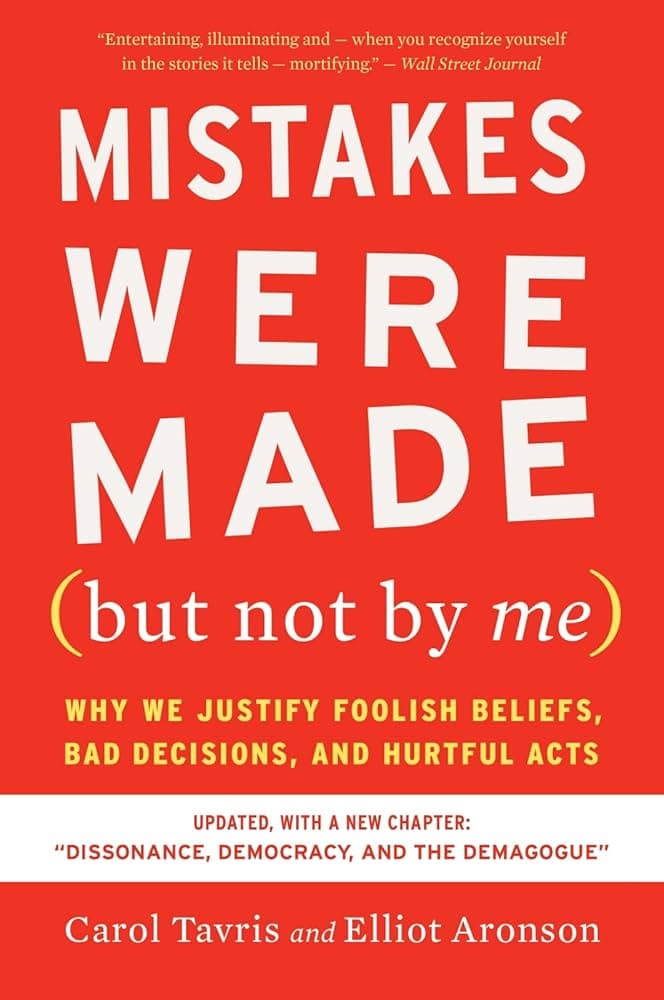

Nearby patterns.
Continued influence effect
Continued influence is misinformation lingering in inference after correction; belief perseverance is the belief itself surviving the debunking of its evidence.
Backfire effect
The backfire effect is the proposed possibility that a correction makes a false belief stronger rather than weaker.
Confirmation bias
Confirmation bias is the tendency to treat evidence as a lawyer for what we already believe rather than a test of whether we are right.
Semmelweis reflex
The Semmelweis reflex is a cognitive bias wherein people tend to reject new evidence or knowledge if it contradicts established norms or beliefs.
Motivated reasoning
Motivated reasoning is the tendency to process information in ways that arrive at the conclusions we want to reach, while experiencing the process as objective.
Conservatism
Conservatism cognitive bias refers to the tendency of individuals to insufficiently revise their beliefs when presented with new evidence.
Learn the wider pattern.
Dive deeper into Belief perseverance and related biases in Reasoning and Logical Fallacieswith structured lessons, examples, and practice exercises.
Entry last reviewed 2026-07-19 · sources verified against the published literature — methodology