Inattentional blindness
Inattentional blindness is the failure to notice a fully visible but unexpected object or event when attention is engaged elsewhere. We don't see with our eyes; we see with our attention — and attention is a narrow beam we systematically overestimate.
How it works
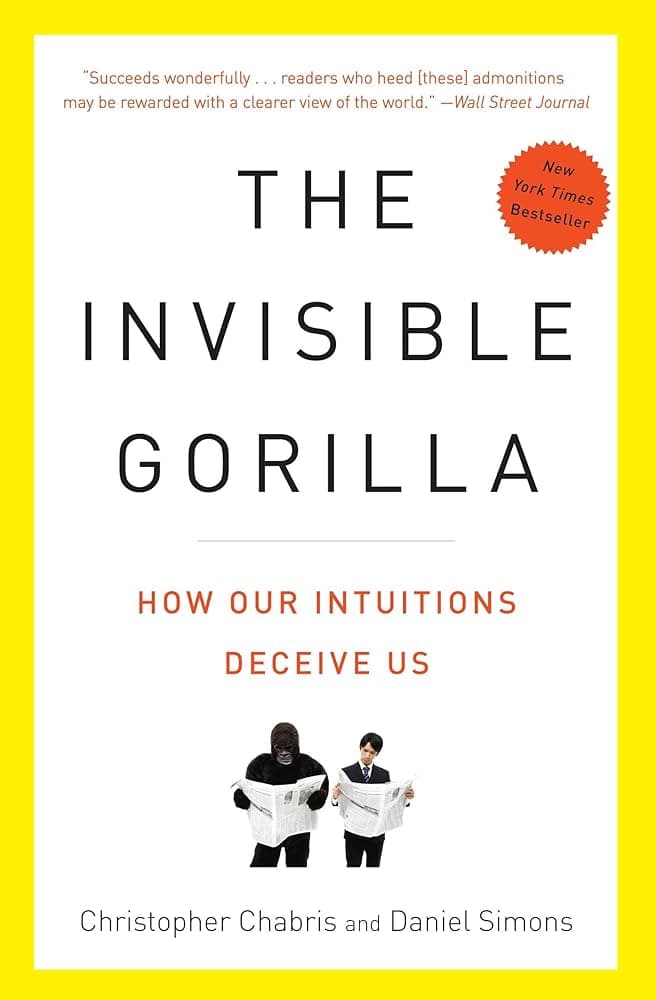
Perception of unexpected objects requires attentional capacity, and demanding tasks consume it. In Simons and Chabris's landmark study, about half of viewers counting basketball passes failed to notice a person in a gorilla suit walking through the scene and thumping their chest. The deeper problem is the meta-error: nearly everyone insists they would have noticed, so the blindness comes with false confidence of full awareness.
Where it shows up
- Radiologists focused on lung nodules failed to notice a gorilla image inserted into a CT scan 48 times larger than the nodules (Drew et al., 2013).
- A driver in conversation looks directly at a motorcyclist and pulls out anyway — 'looked but failed to see' collisions.
- An analyst deep in one dashboard misses the anomaly flashing in an adjacent, unmonitored metric.
What it can distort
- Monitoring tasks fail exactly for the unexpected events monitoring exists to catch, while operators sincerely report full vigilance.
- Eyewitness confidence about 'what was there' vastly overstates what attention actually processed.
How to work around it
- Design for it, don't train against it: alarms and interlocks for critical unexpected events, rather than trusting human noticing.
- Separate the watcher from the doer — a person absorbed in a task cannot also be its safety monitor.
- Calibrate your confidence: 'I was watching and saw nothing' means far less than it feels like it means.
Critiques and limits
Rates vary widely with task load, stimulus similarity, and expectations; it demonstrates limits of unattended perception, not that people are generally oblivious.
Fields of impact
How solid is the research?
Replicated across laboratories, tasks, and expert populations; one of the most reliable phenomena in attention research.
Relevant papers
Simons, D. J., & Chabris, C. F. (1999)
Perception, 28(9), 1059-1074
Drew, T., Võ, M. L.-H., & Wolfe, J. M. (2013)
Psychological Science, 24(9), 1848-1853
Real-world patterns.
When emotion starts driving the decision
A leadership team is reviewing a promising initiative under deadline pressure. Early reactions to the concept are strongly positive, and that emotional tone begins shaping the discussion before anyone has separated likely upside from operational risk.
Context
A team makes a high-stakes decision under time pressure, and their first emotional reaction starts shaping how risky and how promising the option feels.
Situation
Early signals look encouraging, the narrative feels compelling, and the group begins to evaluate the opportunity through that positive feeling instead of separating upside from downside.
The bias in action
The emotional tone of the option begins to stand in for careful analysis, shrinking perceived risk while inflating expected benefit.
Outcome
The decision moves forward with less scrutiny than it would have received under a more explicit risk-benefit review.
Continue reading for the full case, measurable impact, and lessons learned.
Want the full analysis?
Request access to the complete case study, including measurable impact, lessons learned, and the recommended better approach.
Recommended books
Nearby patterns.
Change blindness
Inattentional blindness misses unexpected objects while attending elsewhere; change blindness misses differences across a visual disruption. Both expose how sparse perception is.
Attentional bias
Attentional bias is repeatedly noticing information that fits a current concern, goal, fear, or desire while giving less attention to other relevant signals..
Absent-mindedness
Absent-mindedness is forgetting an intended action or location because attention was elsewhere when the memory cue needed to be created..
Streetlight effect
The streetlight effect is the tendency to search for answers where searching is easiest rather than where the answer is most likely to be — like the drunkard looking for his keys under the streetlight because 'that's where the light is.' In research and analytics, we measure what is measurable and quietly redefine the question to match..
Learn the wider pattern.
Dive deeper into Inattentional blindness and related biases in Perception and Representation Biaseswith structured lessons, examples, and practice exercises.
Entry last reviewed 2026-07-19 · sources verified against the published literature — methodology